Claude Monet: The Man Who Painted Light and Changed Art Forever

What if one of the most recognizable names in art began with someone making fun of a painting?
That is part of Claude Monet’s story. Born November 14, 1840, he helped change how painters approached light, color, and the world around them. His birthday is a good reason to look beyond the familiar water lilies and meet the person who kept looking, experimenting, and painting—even when seeing became difficult.
Before the water lilies, there were caricatures
Growing up in Le Havre, Monet became known for caricatures while still a teenager. Before he was studying reflections, he was exaggerating people’s features.
Landscape painter Eugène Boudin encouraged him to paint outdoors. That introduction to plein air painting—painting in the open air—helped redirect his attention toward nature.
I like that part of his story. A teacher can open a door without knowing how far a student will travel through it. Boudin’s invitation gave Monet a different way to use his eyes and his talent.
The painting behind an insult
In 1874, Monet exhibited Impression, Sunrise with a group of artists showing their work independently in Paris.
The painting shows Le Havre’s harbor through morning haze. Boats and industrial structures emerge from blue-gray mist, while an orange sun and its reflection give the scene a striking focus. We can recognize the harbor without having every detail neatly outlined.
Critic Louis Leroy used the title as ammunition in his mocking review, “The Exhibition of the Impressionists.” Another critic, Jules Castagnary, soon used the term positively. A name associated with ridicule became the identity of an influential movement.
That doesn’t mean Monet painted carelessly. Look at the relationships between the sun, its reflection, and the surrounding colors. The apparent simplicity asks us to notice the whole effect.

Why paint the same thing again?
Monet returned to grainstacks, poplars, and Rouen Cathedral in series. The subject might remain in place, but its appearance kept changing.
Think of a familiar building on a bright morning, then under a storm cloud. Its outlines may be the same, yet the colors, shadows, and feeling of the scene are different.
For the cathedral series, Monet worked from rooms opposite the façade, switching between canvases as the light changed. He later reworked them in his studio. The paintings weren’t simply quick records completed before the sun moved.

A particularly useful comparison is between his grainstacks in summer light and those surrounded by snow at sunset. Looking at them together helps us see why repeating a subject could lead to discovery rather than repetition.


Growing a place to paint
Monet settled in Giverny in 1883. His gardens became subjects he could observe over many years.
In 1893, he acquired additional land and developed the water garden. A diverted stream fed the pond, and a Japanese-style bridge crossed it. The plants and their arrangement were part of the world he deliberately created around himself.
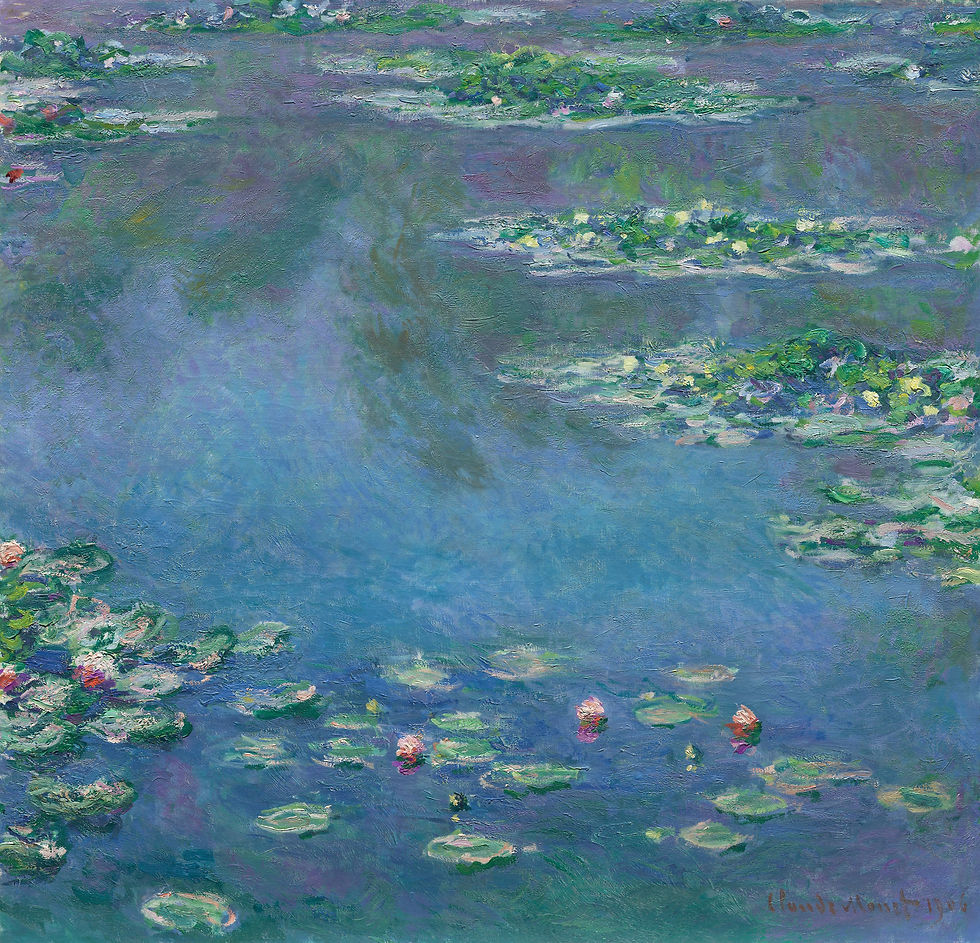
The pond offered far more than flowers. Clouds appeared in its surface; trees became reflections; leaves floated above what looked like sky. Looking at water could mean looking downward and seeing something overhead.
That is one reason his water-lily paintings invite a longer look. The lilies give us something recognizable, while the surrounding reflections can make it difficult to separate water, sky, and vegetation.
When seeing became a struggle
For a painter so attentive to color, cataracts brought a particularly painful challenge.
Monet described colors losing their intensity and reds becoming muddy. He labeled his paint tubes and kept his palette carefully ordered to help him continue working. Imagine reaching for a familiar color and no longer trusting what your eyes tell you.
He feared surgery, knowing that other artists had experienced disappointing results. Eventually, encouraged by his friend Georges Clemenceau, he agreed to an operation on his right eye in early 1923. He was 82.
And yes—cataract surgery existed then. Methods for treating cataracts go back centuries, although Monet’s operation and recovery were very different from today’s procedures.
Recovery didn’t immediately solve everything. He struggled with altered color perception and corrective glasses, and became frustrated with the results. Continuing to paint involved adjustment as well as determination.
His eyesight matters to the story, but it shouldn’t become an explanation for every unusual late painting. We can acknowledge the physical difficulty without dismissing his choices and experiments.
Read the medical-history account of Monet’s cataracts and surgery. Explore the longer history of cataract surgery.
Was Monet’s wet-on-wet the same as Bob Ross’s?
As an oil-painting instructor, this is a distinction I want to make clear.
Wet-on-wet describes applying fresh paint into paint that is still wet. It is a broad practice, rather than one artist’s invention or one fixed recipe.
Monet used it, but that does not mean he always completed a painting in one sitting. Conservators examining Cliff Walk at Pourville found both wet-into-wet and wet-over-dry applications, evidence of work across multiple sessions.
In the Bill Alexander and Bob Ross approach many of us know, a thin wet base commonly helps painters blend and build a landscape during a single session. Particular brushes, paint consistencies, and techniques support that process.
Monet’s visible strokes and neighboring patches of color often serve a different visual purpose. The basic behavior of wet oil paint connects the methods; their procedures and results can differ considerably.
Understanding that gives us a more useful history than saying Monet painted “just like Bob Ross.”
A lesson we can still use
You don’t have to become an Impressionist to learn from Monet.
Before painting a tree, look at what the light is doing to it. Before reaching for gray to paint a shadow, notice whether you can see blue, violet, or reflected warmth. Before painting a pond, ask which colors belong to the water and which belong to its reflections.
Those observations matter in realism, too. We may choose more defined forms or smoother transitions, but careful looking still comes first.
Monet died in 1926, yet his paintings continue to offer that invitation: slow down and look again.
Before you go, you’ll find a short “See It in Practice” section below, connecting Monet’s observations about light and color with paintings from our collection.
Thanks for reading! Please leave a comment and click the heart if you enjoyed this article. Do you have a favorite Monet painting—or a familiar place you’ve watched change with the light?
Hope Blakely — Keeping Happy Trees Alive
See It in Practice: Light, Water, and Today’s Landscape Painting
These are connections in subject and observation, rather than claims that the artists directly based their paintings on Monet.
Golden Meadow — Marion Dutton
Marion’s Golden Meadow interprets Kevin Hill’s Evening Meadow Pond, painted as part of their friendly challenge: Marion took on his landscape, while Kevin painted a dog.
Its warm light and pond give us a contemporary way to consider how illumination shapes a landscape. The more detailed handling differs from Monet’s, but we can ask the same question: what happens to the scene when the light changes?

Sunset on St. Johns River — Sean Mullins
Sean’s river sunset offers a natural connection to Monet’s interest in light reflected across water. With both paintings in view, notice how reflections help establish the time of day and atmosphere.

Smoky Mountain Cascade Pass — Hope Blakely
I painted this Kevin Hill design at a conference in Clarksville, Tennessee. It gives us a technical comparison: the soft transitions possible in contemporary wet-on-wet landscape painting alongside Monet’s more visible strokes.

A water lily on your own easel
Later this November, I’ll be teaching a water-lily painting at the Hansen Museum in Logan, Kansas. Sharing a subject with Monet doesn’t mean copying his style. It gives us an opportunity to explore water, flowers, and reflections through our own painting process.


Comments